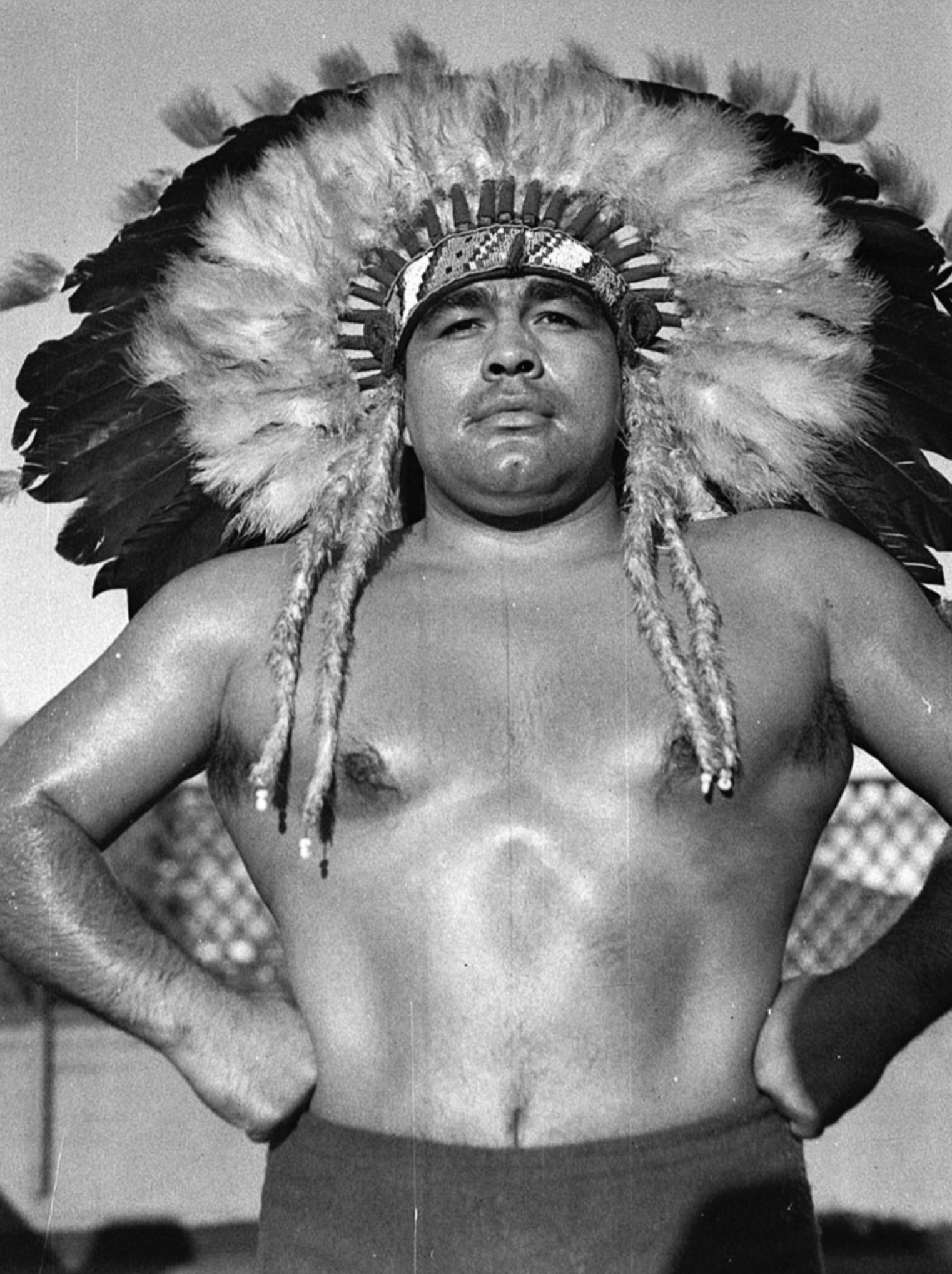
From Hoehne to the World
In the small Colorado community of Hoehne—more cattle than people—Ventura Tenario was born on November 25, 1911. The son of Jose “Joe” Tenario and Maria “Mary” Tenario, he was the second of four children and, according to the locals, a boy with a wrestler’s frame before he even hit his teens. By the time most kids his age were worried about math homework, Ventura was learning how to take a punch, ride a horse, and win over a crowd.
Wrestling would become his passport to the world—a career that took him from New York’s Yankee Stadium to packed Australian showgrounds, with pit stops in New Zealand, Canada, and practically every American arena that could fit a ring. But in the pages of wrestling history, Chief Little Wolf wasn’t just another grappler with a gimmick—he became a folk hero on the other side of the planet.
The Man Behind the Headdress
Ventura Tenario didn’t need Hollywood agents to create a persona. Wrestling as Chief Little Wolf—or, when the mood struck, Big Chief Little Wolf—he leaned into a Native American identity that, while undoubtedly theatrical, also carried an aura of dignity and pride rare for the era.
He married three times—first to Irene Olive, later to Dorothy Helen Pratt, and finally to Audrey Lillis “Dona” Corner, an Australian woman with whom he had his daughter, Markeeta. Markeeta would go on to be a teenage pop sensation in Australia before switching careers entirely, becoming a mayor in Washington State.
But Ventura’s family ties extended into the ring, too. His brother Ernesto wrestled as Chief Lone Wolf, proving that in the Tenario family, headlocks were a more natural inheritance than silverware.
Wrestling the World
Tenario’s wrestling résumé reads like a roll call of mid-20th century mat legends: Lou Thesz, Gorgeous George, Bronko Nagurski, Man Mountain Dean, Jim Londos—the list is a who’s who of classic pro wrestling. Between 1932 and 1958, he logged 1,141 matches: 501 wins, 178 draws, and 357 defeats. For two decades, he was one of the most durable—and marketable—performers in the business.
In 1935, he nearly got a shot at heavyweight gold against Londos, but Londos skipped out, earning suspensions in multiple states. That same year, Tenario fought Danno O’Mahoney at Yankee Stadium in front of a massive crowd. He lost, but the match cemented him as a main-event draw.
Australia: His Second Home
When Tenario arrived in Auckland in June 1937, he might have looked like just another traveling wrestler. By the time he left, he had sparked a sporting romance that would keep him in Australia and New Zealand for much of his career.
From 1937 to 1958, he wrestled more than a thousand matches in Australia, facing over a hundred different opponents. He wasn’t just a stadium draw—he was a touring attraction. With his traveling tent show, he blended wrestling exhibitions with Navajo stories and horse-riding stunts, claiming in 1953 that three-quarters of Australians had seen him live.
It wasn’t all glory. In 1946, fresh from World War II service in the European Theater, he broke his leg in Chicago so badly that doctors doubted he’d wrestle again. He proved them wrong—returning to Australia to finish his career in front of the fans who adored him.
The Ringmaster’s Praise
Australian wrestling journalist “Ringmaster” once summed him up perfectly: “His capacity for absorbing punishment seems unlimited, and he has the power and stamina to keep handing it out indefinitely.”
That endurance made him a nightmare for opponents and a dream for promoters. He could take a beating, rally the crowd, and stage a comeback that had fans on their feet every time.
Not Just a Wrestler—A Folk Hero
Barry York, an Australian National University researcher, once put out a public call for stories about Chief Little Wolf. The response was staggering—over 700 letters poured in from ex-wrestlers, nurses, fans, and casual acquaintances.
The recurring themes? He was approachable, kind-hearted, generous, and larger-than-life. He was the rare celebrity who could share a beer at the pub, pose for a photo at the corner store, or tell a story that made you feel like you’d known him forever.
To Australians, he wasn’t just an exotic sportsman from America—he was “their” Chief.
One for the Courts
Tenario’s career wasn’t without its wild side stories. In 1940, during a match with Terry McGinnis in Sydney, a brawl spilled out of the ring and onto radio commentator Captain Tom Bairnsfather—literally. The Captain claimed serious injuries and sued Tenario, McGinnis, and the stadium for £2,000. Tenario was briefly bonded and released, the case fizzled out, and he returned to wrestling, with the whole affair becoming part of his larger-than-life legend.
The Final Bell
His last match in Australia came on November 10, 1956, when he teamed with “Great Zorro” to defeat “Lucky” Simunovich and Dr. Jerry Graham in a tag team bout. A short U.S. comeback in 1957 was cut short when he suffered a massive stroke the following year.
The stroke ended not just his career, but his working life entirely. He spent nearly two decades in an Australian care facility before returning to the United States in 1980. He died in Seattle on November 13, 1984—just shy of his 73rd birthday.
Legacy
Chief Little Wolf wasn’t a world champion, but he didn’t need a belt to prove his worth. His record, his travels, and his popularity in a country half a world away from his birthplace cemented his place in wrestling history.
More than a wrestler, he was a showman, a storyteller, and, to thousands of Australians, a friend. In the squared circle, he was relentless. Outside it, he was warm. And in the collective memory of a generation of fans, he remains forever the Chief who brought a touch of the Wild West—and a lot of heart—to the wrestling rings Down Under.